

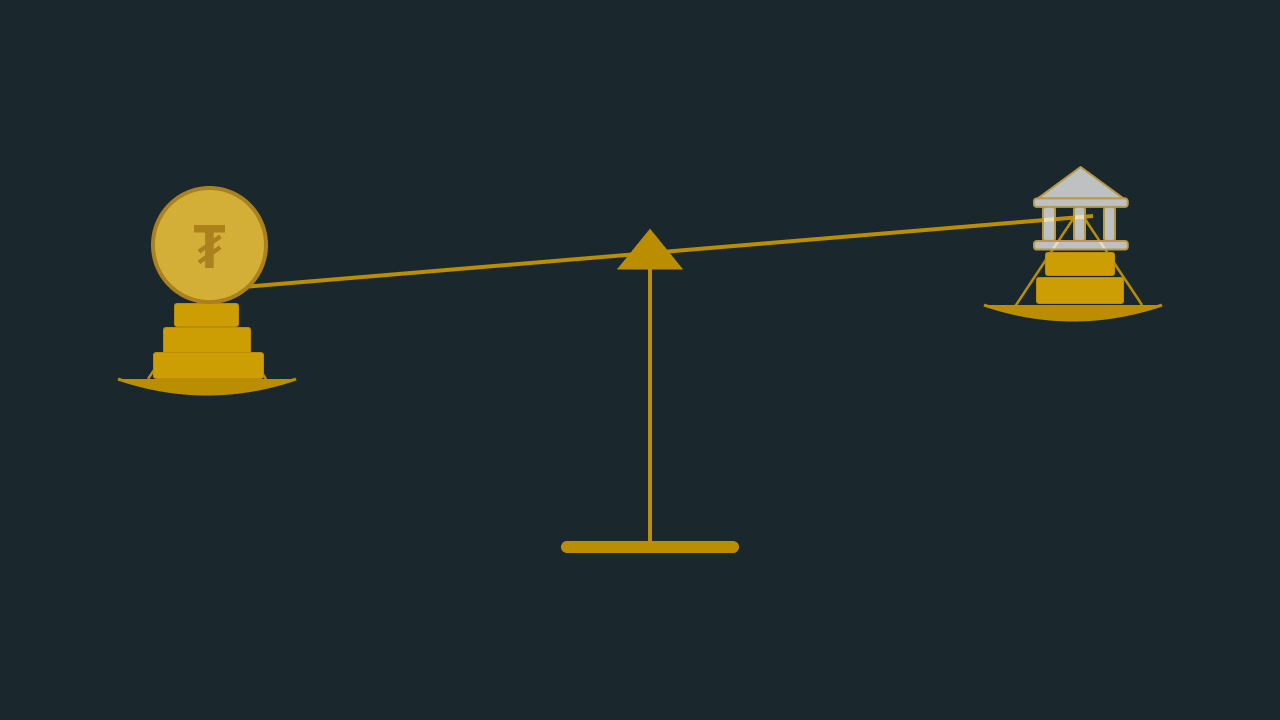
Tether holds 132 tonnes of gold — verified by BDO. Over six quarters, it bought more than China’s PBoC cumulatively. Here is what that data means, what it doesn’t mean, and why the distinction matters.
132t · 73.6t · vs 49.1t
Tether gold holdings Q1 2026 (BDO-attested) · 6-quarter cumulative purchases · vs China PBoC over the same period
132 tonnes — verified, attested, publicly disclosed
Tether’s Q1 2026 reserve attestation, independently prepared by BDO and published May 4, confirmed that the company holds 132 tonnes of gold as part of its corporate reserves. This places Tether among the top 30 gold holders globally — ahead of the central banks of Greece, Qatar, Australia, and a dozen other sovereign institutions.
The six-quarter comparison with China’s PBoC is striking in its own right: between December 2024 and March 2026, Tether’s cumulative gold purchases totalled approximately 73.6 tonnes, compared to China’s 49.1 tonnes over the same period. Tether’s buying peaked in Q3 and Q4 2025 — 21.99 tonnes and 21.49 tonnes respectively — periods in which it was the single largest gold buyer of any institution reporting to the World Gold Council.
In Q1 2026, the pace slowed: Tether bought 6.52 tonnes, modestly behind China’s 7.15 tonnes in the same quarter. The “Tether buying more than China” narrative is accurate on a cumulative 6-quarter basis, but the most recent quarter saw China slightly ahead. The cumulative picture is genuine. The present-tense framing requires the qualifier.
Quarterly gold purchases — Tether vs China PBoC (tonnes)
Tether peaked in Q3–Q4 2025. China’s pace held more steady. Hover for the differential each quarter.
Sources: World Gold Council · Bloomberg · Katusa Research · Tether Q1 2026 reserve attestation (BDO, May 4, 2026).
The correct framing, clearly stated
What Tether’s gold buying is
Corporate treasury diversification. Tether’s CEO Paolo Ardoino has stated publicly that these purchases come from company profits — not the $190 billion in customer reserves that back USDT. This is a decision about how to hold corporate profits, analogous to a company putting cash reserves into real assets rather than money market funds.
Collateral resilience. Tether uses gold as part of the broader reserve architecture supporting its stablecoin. Holding hard assets alongside dollar-denominated instruments reduces counterparty risk in the reserve portfolio — the same logic central banks use.
A new category of structural gold buyer. Tether represents a type of institution — crypto-native financial infrastructure — that did not exist in previous gold cycles. Its demand is not rate-sensitive in the way ETF flows are, and it does not respond to short-term price moves in the way tactical traders do.
What Tether’s gold buying is not
A monetary policy statement. Tether is not a central bank. Its gold purchases do not reflect national reserve policy, geopolitical positioning, or a formal de-dollarization strategy. They reflect corporate financial management decisions.
A signal of financial distress. Independent attestations confirm that Tether’s USDT is backed by adequate reserves. The gold purchases are from profits and represent strength, not stress.
A directional forecast for gold prices. Tether’s gold buying does not imply any view about future gold price direction. It is a reserve asset allocation decision, not a trading signal.
A private company built to hold dollars is holding gold alongside them
The distinction between “what it is” and “what it isn’t” matters for accuracy. But having made it clearly, the data point retains its significance. Tether is a company whose entire business model is predicated on the utility of the U.S. dollar — it issues dollar-pegged stablecoins, its reserves are predominantly in dollar-denominated instruments, and its core value proposition is dollar stability. When that company allocates a meaningful portion of its profits to physical gold, the signal is worth examining.
It is not a conspiracy. It is not a dramatic anti-dollar statement. It is a financial institution with sophisticated treasury management capabilities deciding that holding dollars alone — even at a period of elevated interest rates — leaves the reserve portfolio exposed to risks that gold can partially hedge. What those risks are, Tether’s public communications make clear: currency debasement over time, counterparty risk in the dollar-denominated financial system, and the value of holding an asset that cannot default or be frozen.
GBI economist Trey Reik identifies anti-dollar sentiment as one of three structural forces driving gold’s current advance. The assumption behind that thesis has been that this sentiment manifests primarily through central bank reserve diversification — sovereigns moving away from dollar-denominated reserves following Russia’s asset freeze in 2022. The Tether data suggests the same sentiment is appearing in a completely different institutional category. Not sovereign, but private. Not state monetary policy, but corporate financial strategy. The conclusion — hold gold alongside dollars as a counterparty-free reserve asset — is the same.
The broader pattern
Tether is not alone. The World Gold Council has noted a broader trend of non-sovereign institutional buyers — stablecoin issuers, sovereign wealth funds, corporate treasuries, and technology companies — entering gold markets in volumes once associated only with central banks. Investment bank Jefferies noted that Tether’s Q3 2025 purchase of 26 tonnes made it the single-largest gold buyer of any institution in that quarter, larger than any single central bank. The buyer landscape for gold is widening in ways that were not present in previous cycles.
What a widening buyer landscape means for long-term holders of physical gold
The practical significance of the Tether data for investors in physical gold is not that it predicts near-term price moves — it doesn’t. It is that it provides evidence of a structural widening in the buyer base for gold that is independent of the traditional factors (ETF flows, Western institutional demand, retail jewellery) that have historically driven gold’s price cycles.
Gold’s near-term price is set at the margin by the most price-sensitive buyers — ETF investors who rotate in and out based on real yield signals. Those buyers are currently rotating out, as today’s CPI beat and the resulting rate hike probability increase demonstrates. Gold fell from $4,773 to $4,694 in two hours this morning. That is the margin-setter at work.
The floor is being set by the structural buyers — central banks, physical accumulators like Tether, long-horizon sovereign wealth funds. These buyers are not reacting to this morning’s CPI print. The floor has held: gold has not revisited the $4,300 technical bull-bear line analysts have been watching, despite weeks of real yield headwinds. That is what 60+ tonnes of monthly structural buying looks like in practice. Not a dramatic rally. A floor.
Investor implication: The structural bid is widening to include institutional categories that did not participate in previous gold cycles. For long-term holders of physical gold, this is not a near-term price catalyst — it is evidence that the structural floor is being reinforced by a broader and more durable set of buyers than in any previous cycle.
“The company built to hold dollars is holding gold alongside them. Different motivation from a central bank. The same asset. The same conclusion about what belongs in a sound reserve portfolio.”
- Tether holds 132 tonnes of gold as of Q1 2026 — BDO-attested. 6-quarter cumulative purchases: 73.6t vs China PBoC’s 49.1t over the same period
- These purchases come from Tether’s profits, not USDT customer reserves — a corporate treasury decision, not a monetary policy statement
- The “buying more than China” framing is accurate on a 6-quarter cumulative basis; in Q1 2026 specifically, China bought slightly more (7.15t vs 6.52t)
- Tether represents a new category of structural gold buyer — crypto-native financial infrastructure — that did not exist in previous gold cycles
- The buyer base for gold is widening beyond central banks into private institutional categories — the same conclusion (hold gold as a counterparty-free reserve asset) reached by a different type of institution
- Structural buyers set the floor; tactical buyers (ETFs) set the daily price. The floor has held despite weeks of real yield headwinds — that is the structural bid doing its job
Own gold the professional way. GBI Direct offers fully allocated gold and silver storage through Brinks and Loomis vaults, with institutional-grade custody and live-market liquidity. Accounts open in under 10 minutes.
Sources: Tether Q1 2026 reserve attestation (BDO, published May 4, 2026); Cointelegraph (Tether gold buying analysis, December 2025); World Gold Council Q1 2026; Jefferies research (Tether Q3 2025 analysis); Katusa Research (PBoC comparison chart, May 2026); CoinMarketCap (Tether market cap, May 12, 2026).
Not financial advice. For educational purposes only.