

Less than two hours before his 8 p.m. Eastern deadline — with the world waiting and oil briefly trading above $117 a barrel — President Trump announced a conditional two-week ceasefire with Iran.
The announcement came via Truth Social. The terms: a suspension of U.S. and Israeli strikes in exchange for the “complete, immediate, and safe opening” of the Strait of Hormuz. Iran conditionally agreed. Pakistan’s Prime Minister Shehbaz Sharif helped broker the deal in last-minute diplomacy.
Markets moved instantly and dramatically. Oil plunged more than 16% to below $94 a barrel — one of its sharpest single-session drops in years. The S&P 500 surged more than 2.5%. Asian markets opened sharply higher. South Korea’s Kospi jumped over 5%. Japan’s Nikkei rose 4%.
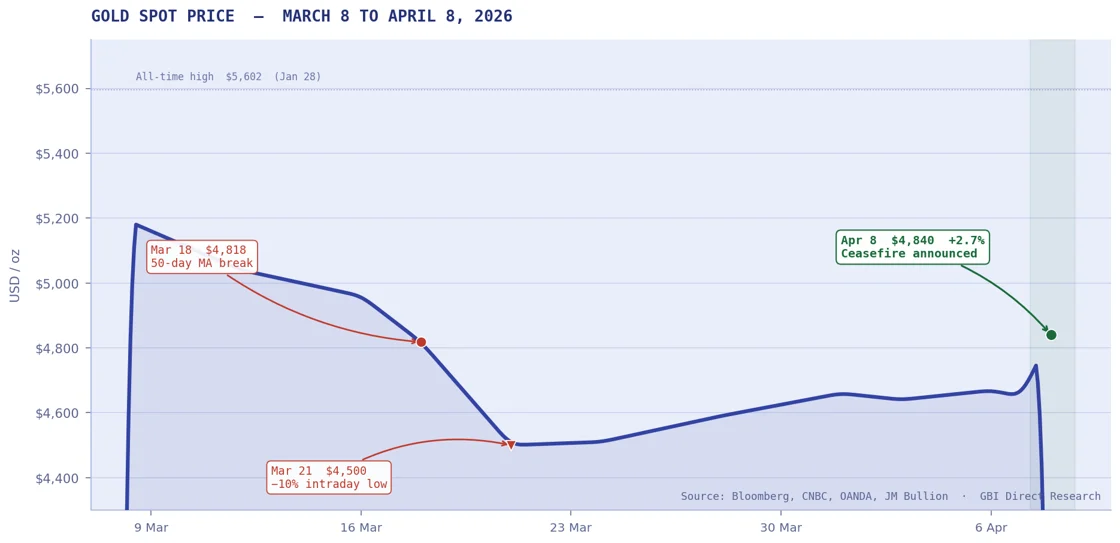
And gold? Gold climbed 2.7% to $4,840 an ounce — its highest level since March 19. And the move wasn’t limited to gold: the entire precious metals complex surged, with silver up 6.4%, platinum up 4.3%, and palladium up 5.0%.
If that seems counterintuitive, it shouldn’t. Yesterday’s article explained why the war was working against gold. Today’s move is that same mechanism running in reverse.
The Chain Running in Reverse
Yesterday we wrote that the Iran war was suppressing gold through a specific chain: the Hormuz closure spiked oil, which spiked inflation fears, which killed Fed rate-cut expectations, which raised the opportunity cost of holding gold. That four-link chain was the entire mechanism.
Last night, the ceasefire announcement broke the first link. Here’s what the reversal looks like:
The Reversal Chain
1: Ceasefire announced; Strait may reopen. Iran agrees to allow safe tanker passage for two weeks. Oil supply disruption fears ease immediately.
2: Oil crashes -16.5%. WTI falls from $117 intraday to below $94. Brent drops below $100. The inflation fuel that had been feeding into every CPI projection for March and April begins to cool.
3: Inflation expectations ease. The oil shock that was projected to push March CPI to its biggest monthly jump since 2022 no longer looks as severe if oil stays near $94. The OECD’s 4.2% U.S. inflation forecast for 2026 starts to look aggressive.
4: Fed rate-cut probability revives. Over the past six weeks, futures markets priced out all rate cuts for 2026. If oil remains lower, the inflation argument for holding rates high weakens. Cut expectations re-enter market pricing — today, FOMC minutes from March give further clues on the Fed’s thinking.
5: Dollar falls. DXY dropped -0.8% on the announcement. A weaker dollar makes gold — priced in USD — more affordable for international buyers, adding direct upward price pressure.
6: Gold rallies. The headwind is gone. Lower oil, softer inflation, a possible path to rate cuts, a weaker dollar — all four of gold’s suppressors from the past six weeks are now reversing simultaneously.
This is not a contradictory outcome. It is a mechanically coherent one. The war was bad for gold not because of geopolitical fear, but because of what it did to oil and the Fed. Remove that dynamic, and gold’s structural bull case reasserts itself immediately.
Silver’s Bigger Move
If gold’s rally raised eyebrows, silver’s was more dramatic. Silver jumped 6.4% to $78.09 an ounce — outperforming gold by a wide margin in a single session.
The explanation is the mirror image of why silver underperformed during the conflict. Silver’s industrial demand component — roughly 50–60% of total demand — made it doubly exposed to the war’s economic damage: oil-driven manufacturing slowdowns, supply chain disruption, reduced industrial activity globally. The ceasefire announcement removes those headwinds simultaneously with gold’s monetary ones.
Silver also had more ground to make up. The gold/silver ratio had widened significantly during the conflict as silver absorbed the industrial demand hit harder than gold. Reversion from that extreme can be fast — as today’s session demonstrates.
What the Skeptics Are Saying — And Why It Matters
Not everyone is reading this as a clean turning point.
The two-week ceasefire is conditional, short, and subject to breakdown at any point. Iran must keep the Strait open. Talks must progress. If either condition fails, the conflict could resume — and oil, inflation fears, and gold’s headwind could return quickly.
GasBuddy analyst Patrick De Haan was blunter: two weeks likely means “another two weeks of status quo and barely anything getting through the Strait,” suggesting the physical oil supply situation may not normalize as quickly as oil futures are pricing.
This skepticism is not bearish for gold — it’s actually an argument for continued strength. If the ceasefire holds and talks progress toward a permanent resolution, lower oil enables rate cuts, which is bullish for gold. If the ceasefire breaks down and the conflict resumes, geopolitical safe-haven demand returns — also bullish for gold. The asymmetry favors holders.
“Since the war began, bullion has traded largely in tandem with stocks — its traditional haven appeal dimmed by investors’ need to cover losses elsewhere.”
— Bloomberg, April 8, 2026
What to Watch Today
- FOMC Minutes (today)
March meeting minutes release today. Markets will scan for any shift in Fed tone on inflation now that oil has dropped sharply. Any hint that rate cuts become more viable in 2026 would add further fuel to gold’s move.
- Strait Traffic (this week)
The test of the ceasefire is physical — do tankers actually start moving through the Strait of Hormuz? Marine traffic data over the next 48–72 hours will be the first real signal of whether the oil market’s relief rally is justified.
- 30-Year Auction (today)
The U.S. Treasury auctions 30-year bonds today. With yields falling on the ceasefire news, demand for long-dated debt may be stronger — a positive read on U.S. borrowing conditions and a further dollar headwind.
- Islamabad Talks (next 2 weeks)
Permanent resolution talks are expected in Islamabad during the ceasefire window. Progress here — or breakdown — will set the next directional move for oil, the dollar, and gold.
The Bigger Picture Hasn’t Changed
Yesterday gold was at $4,650. Today it’s at $4,832. The $182 move in a single session is the market repricing one specific headwind — the oil-inflation-Fed chain — not the entire investment thesis.
The structural case for gold remains exactly where it was before the war began and before the ceasefire: central banks buying at historically elevated rates, a U.S. fiscal trajectory that shows no signs of reversing, a long-run de-dollarization trend, and real yields that remain well below the levels needed to make financial assets a compelling alternative to hard assets over multi-year horizons.
J.P. Morgan’s year-end target of $5,055. Goldman’s $5,400. Bank of America’s $6,000. None of those moved during the six weeks of war. None of them needed to move today either. What today’s session shows is what happens when a specific, temporary headwind lifts — the underlying structural bid reasserts itself, fast.
The two weeks ahead will tell us whether yesterday’s ceasefire was a turning point or a pause. Either way, the metal that waited through six weeks of oil-driven suppression just made its position clear.
EDUCATIONAL & INFORMATIONAL PURPOSES ONLY — This is not financial advice. Data sourced from Bloomberg, CNBC, Mining.com, FX Leaders, NBC News, Al Jazeera, and CoinCentral. Analyst price targets cited for informational context only. Precious metals involve risk; past performance is not indicative of future results.